GINI coefficient: Difference between revisions
Jump to navigation
Jump to search
m (Text replace - "|Status=Publishable" to "") |
No edit summary |
||
| Line 1: | Line 1: | ||
{{VariableTemplate | {{VariableTemplate | ||
|Label=GINI coefficient | |Label=GINI coefficient | ||
|Description=The GINI coefficient is a measure of income disparity in a population. If all enjoy the same income, GINI equals unity. The lower the GINI is, the wider is the gap between the lowest and highest income groups. | |Description=The GINI coefficient is a measure of income disparity in a population. If all enjoy the same income, GINI equals unity. The lower the GINI is, the wider is the gap between the lowest and highest income groups. | ||
| Line 6: | Line 5: | ||
|IsImpactIndicator=No | |IsImpactIndicator=No | ||
|Source2= | |Source2= | ||
| | |BasedOn2= | ||
|Reference2= | |||
|DriverGroup=Economic development | |DriverGroup=Economic development | ||
|Source=World Bank | |Source=World Bank database; | ||
|ExternalModel= | |ExternalModel= | ||
}} | }} | ||
Revision as of 12:10, 13 January 2014
| Label: | GINI coefficient |
| Description: | The GINI coefficient is a measure of income disparity in a population. If all enjoy the same income, GINI equals unity. The lower the GINI is, the wider is the gap between the lowest and highest income groups. |
| Variable type: | driver |
| Driver group: | Economic development |
| Source: | World Bank database; |
Drivers are described in the Drivers component.
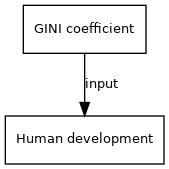
Variable is input of model component(s):
- Click on a box to open the model component.