Carbon cycle and natural vegetation/Description: Difference between revisions
Jump to navigation
Jump to search
m (RinekeOostenrijk moved page Natural vegetation and carbon cycle/Description to Carbon cycle and natural vegetation/Description without leaving a redirect) |
m (Text replace - "Vegetation, hydrology and agriculture" to "Carbon, vegetation, agriculture and water") |
||
| Line 1: | Line 1: | ||
{{ComponentDescriptionTemplate | {{ComponentDescriptionTemplate | ||
|Description={{DisplayFigureTemplate|Biome classification flowchart NVCC}} | |Description={{DisplayFigureTemplate|Biome classification flowchart NVCC}} | ||
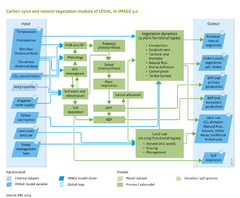
The Carbon cycle and natural vegetation model is part of the [[ | The Carbon cycle and natural vegetation model is part of the [[Carbon, vegetation, agriculture and water|Carbon, vegetation, agriculture and water component]] (IMAGE LPJml). The [[LPJml model]] is a Dynamic Global Vegetation Model ([[hasAcronym::DGVM]]), initially developed to assess the role of the terrestrial biosphere in the global carbon cycle (Prentice et al., 2007). | ||
===Vegetation types=== | ===Vegetation types=== | ||
DGVMs simulate vegetation distribution and dynamics, using the concept of multiple plant functional types ([[hasAcronym::PFT]]s) that are differentiated according to their bioclimatic (e.g. temperature requirement), physiological, morphological, and phenological (e.g. growing season) attributes, and that compete for resources (i.e. light and water). In order to aggregate the vast diversity of plant species in the world, with respect to the most important differences for the carbon cycle, Carbon cycle and natural vegetation model distinguishes [[Plant functional types|nine PFTs]]. Plant dynamics are computed for each PFT present in a grid cell. Since IMAGE uses the concept of biomes (the [[Land cover types|Natural vegetation types]]), combinations of PFTs in an area/grid cell are translated into a certain biome type (see figure on the right: Biome classification flowchart). In the IMAGE framework there is one modification to LPJml, namely the biome ‘ice’, for biomes initially defined as ‘arctic tundra’, and with an average annual temperature of < -2 oC and an annual net primary production (NPP) of < 1 Pg.yr-1. All carbon pools and fluxes in this biome are set to zero. | DGVMs simulate vegetation distribution and dynamics, using the concept of multiple plant functional types ([[hasAcronym::PFT]]s) that are differentiated according to their bioclimatic (e.g. temperature requirement), physiological, morphological, and phenological (e.g. growing season) attributes, and that compete for resources (i.e. light and water). In order to aggregate the vast diversity of plant species in the world, with respect to the most important differences for the carbon cycle, Carbon cycle and natural vegetation model distinguishes [[Plant functional types|nine PFTs]]. Plant dynamics are computed for each PFT present in a grid cell. Since IMAGE uses the concept of biomes (the [[Land cover types|Natural vegetation types]]), combinations of PFTs in an area/grid cell are translated into a certain biome type (see figure on the right: Biome classification flowchart). In the IMAGE framework there is one modification to LPJml, namely the biome ‘ice’, for biomes initially defined as ‘arctic tundra’, and with an average annual temperature of < -2 oC and an annual net primary production (NPP) of < 1 Pg.yr-1. All carbon pools and fluxes in this biome are set to zero. | ||
Revision as of 10:22, 17 May 2014
Parts of Carbon cycle and natural vegetation/Description
| Component is implemented in: |
|
| Related IMAGE components |
| Models/Databases |
| Key publications |
| References |