Impacts: Difference between revisions
Jump to navigation
Jump to search
No edit summary |
No edit summary |
||
| Line 5: | Line 5: | ||
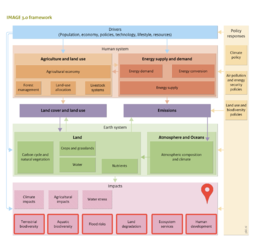
This chapter presents an overview of the indicators that may be assessed using the IMAGE model. Specific impact modules are presented in subsequent dedicated sections. Below, all indicators that originate from the modules in the core model are briefly described: | This chapter presents an overview of the indicators that may be assessed using the IMAGE model. Specific impact modules are presented in subsequent dedicated sections. Below, all indicators that originate from the modules in the core model are briefly described: | ||
The impact indicators derived from the core model span a very wide range; examples often reported in assessment studies include: | [[The impact indicators derived from the core model span a very wide range; examples often reported in assessment studies include: | ||
• Energy supplied, traded, converted and consumed (Section 4.1) | • Energy supplied, traded, converted and consumed (Section 4.1) | ||
• Production of agricultural, animal and forestry products (Section 4.2.1) | • Production of agricultural, animal and forestry products (Section 4.2.1) | ||
| Line 17: | Line 17: | ||
• Nutrient balances and their fate in soils and surface waters (Section 6.4) | • Nutrient balances and their fate in soils and surface waters (Section 6.4) | ||
• Atmospheric concentration and radiative forcing of greenhouse gases and other forcing agents (Section 6.5) | • Atmospheric concentration and radiative forcing of greenhouse gases and other forcing agents (Section 6.5) | ||
• Global average temperature; temperature and precipitation changes per grid cell; sea level rise (Section 6.5) | • Global average temperature; temperature and precipitation changes per grid cell; sea level rise (Section 6.5)]] | ||
Revision as of 16:22, 12 December 2013
|
Composition of Impacts |