Impacts: Difference between revisions
Jump to navigation
Jump to search
No edit summary |
No edit summary |
||
| Line 3: | Line 3: | ||
|Status=On hold | |Status=On hold | ||
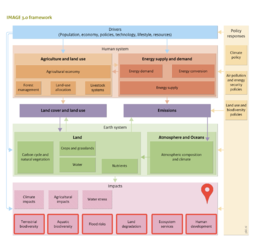
|Description=The various IMAGE 3.0 modules for the socio-economic system and the earth system, as described in the previous chapters, are closely coupled and linked via multiple feedback mechanisms, and, thus, form the ‘core model’ of IMAGE 3.0. These modules typically produce two types of output. One to serve as input in other parts of IMAGE, the other to describe impacts in the form of end-indicators in their own right. In practice, many indicators do serve both purposes, and many state variables of the IMAGE core modules constitute interesting impact indicators, such as of land-use change, crop yields and climate parameters. Over time, researchers and policy analysts became interested in expanding the list of impacts beyond what the core model could provide. As a result, a suite of additional impact modules was developed and linked with the IMAGE core model through a static exchange of data. In other words, these impact modules can be invoked if and when desired to address specific fields of interest, and they have proven very helpful to explore interactions between very different issues of sustainable development. | |Description=The various IMAGE 3.0 modules for the socio-economic system and the earth system, as described in the previous chapters, are closely coupled and linked via multiple feedback mechanisms, and, thus, form the ‘core model’ of IMAGE 3.0. These modules typically produce two types of output. One to serve as input in other parts of IMAGE, the other to describe impacts in the form of end-indicators in their own right. In practice, many indicators do serve both purposes, and many state variables of the IMAGE core modules constitute interesting impact indicators, such as of land-use change, crop yields and climate parameters. Over time, researchers and policy analysts became interested in expanding the list of impacts beyond what the core model could provide. As a result, a suite of additional impact modules was developed and linked with the IMAGE core model through a static exchange of data. In other words, these impact modules can be invoked if and when desired to address specific fields of interest, and they have proven very helpful to explore interactions between very different issues of sustainable development. | ||
[[This chapter presents an overview of the indicators that may be assessed using the IMAGE model. Specific impact modules are presented in subsequent dedicated sections. Below, all indicators that originate from the modules in the core model are briefly described | [[*****]]This chapter presents an overview of the indicators that may be assessed using the IMAGE model. Specific impact modules are presented in subsequent dedicated sections. Below, all indicators that originate from the modules in the core model are briefly described | ||
|FrameworkElementType=impact component | |FrameworkElementType=impact component | ||
|? HasOutputVar=is output from | |? HasOutputVar=is output from | ||
}} | }} | ||
Revision as of 16:23, 12 December 2013
|
Composition of Impacts |