Carbon cycle and natural vegetation: Difference between revisions
Jump to navigation
Jump to search
No edit summary |
No edit summary |
||
| Line 13: | Line 13: | ||
==== Modelling==== | ==== Modelling==== | ||
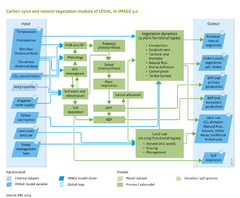
Terrestrial carbon-cycle and vegetation models contribute to a better understanding of the dynamics of the terrestrial biosphere related to the underlying processes and their relation to the terrestrial water cycle (see Section 6.3) and land use (see [[Agricultural economy and forestry]]). The [[LPJmL model]] ([[Sitch et al., 2003]]; [[Gerten et al., 2004]]; [[Bondeau et al., 2007]]) replaces the earlier IMAGE-2 carbon cycle and biome model ([[Klein Goldewijk et al., 1994]]; [[Van Minnen et al., 2000]]). Here, we give a general overview of the LPJmL model in the IMAGE context, with a focus on carbon and biome dynamics. For a detailed description of the IMAGE-[[LPJ | Terrestrial carbon-cycle and vegetation models contribute to a better understanding of the dynamics of the terrestrial biosphere related to the underlying processes and their relation to the terrestrial water cycle (see Section 6.3) and land use (see [[Agricultural economy and forestry]]). The [[LPJmL model]] ([[Sitch et al., 2003]]; [[Gerten et al., 2004]]; [[Bondeau et al., 2007]]) replaces the earlier IMAGE-2 carbon cycle and biome model ([[Klein Goldewijk et al., 1994]]; [[Van Minnen et al., 2000]]). Here, we give a general overview of the LPJmL model in the IMAGE context, with a focus on carbon and biome dynamics. For a detailed description of the IMAGE-[[LPJ model|LPJ]] C cycle model and a sensitivity analysis, see (Müller et al., 2013<ref>[[Müller et al.,b (unpublished)]]</ref>). | ||
<references/> | <references/> | ||
}} | }} | ||
[[HasOutputVar::Terrestrial C balance| ]] | [[HasOutputVar::Terrestrial C balance| ]] | ||
Revision as of 17:06, 16 December 2013
Parts of Carbon cycle and natural vegetation
| Component is implemented in: |
|
| Related IMAGE components |
| Models/Databases |
| Key publications |
| References |

Key policy issues
- What is the role of the terrestrial biosphere in the global carbon cycle, how will it change in time as a result of climate and land-use change?
- To what extent can the terrestrial biosphere contribute to reducing the accumulation of CO2 in the atmosphere and what are viable mechanisms?
- What opportunities exist to reduce land-use related carbon emissions (e.g. REDD) and even enhance the carbon uptake through the establishment of new forests.
- What are the contributions of land-use change, climate change and CO2 fertilization on the future carbon cycle and how can these be considered in climate policies?
Introduction