Carbon cycle and natural vegetation/Description: Difference between revisions
Jump to navigation
Jump to search
No edit summary |
No edit summary |
||
| Line 8: | Line 8: | ||
===Model linkage and simulation procedure=== | ===Model linkage and simulation procedure=== | ||
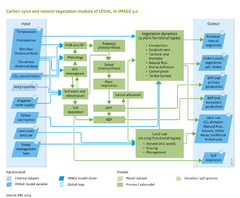
Before the IMAGE-LPJml coupled simulation is started, vegetation and soil carbon pools need to be initialised. This is achieved by using LPJmL first in a 1000-year spin-up in order to initialise the natural ecosystems and their carbon pools and fluxes. This is followed by a 390-year spin-up, in which the agricultural land is gradually expanded based on historical [[HYDE database| HYDE land-use data]]. Timber product pool sizes of 1970 are based on literature estimates (Lauk et al., 2012). The coupled IMAGE-LPJmL simulations start in 1970 with observed climate, followed by simulated climate for the years from 2000 onwards (Section 6.5). As the interannual variability of weather conditions is needed for the simulation of vegetation dynamics in IMAGE-LPJmL, smooth annual climate trends from IMAGE are superimposed by interannual variability fields, extracted from observed climate over the 1971–2000 period. To avoid repeating climate trends within these 30-year periods, annual anomalies are ordered at random before superimposition. | |||
}} | }} | ||
Revision as of 12:35, 7 January 2014
Parts of Carbon cycle and natural vegetation/Description
| Component is implemented in: |
|
| Related IMAGE components |
| Models/Databases |
| Key publications |
| References |