Terrestrial biodiversity/Policy issues: Difference between revisions
Jump to navigation
Jump to search
m (Text replace - "|Status=On hold" to "") |
No edit summary |
||
| Line 1: | Line 1: | ||
{{ComponentPolicyIssueTemplate | {{ComponentPolicyIssueTemplate | ||
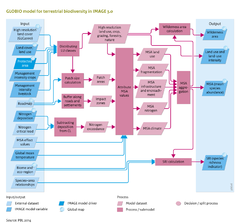
|Description=The GLOBIO model has been used regularly to evaluate biodiversity impacts under baseline scenarios. Although the exact decline depends on scenario assumptions, taken together, these studies all project biodiversity to decline over the next decades at a rate that is similar to that in the previous ones. The main drivers of biodiversity loss are land-use change, infrastructural expansion and, increasingly, climate change (Figure 7.1.2). | |||
|Example=Biodiversity loss can be caused by a wide range of activities in various sectors. Consequently, policy interventions in several major sectors also could prevent or reduce biodiversity loss. The most often suggested option in relation to biodiversity conservation is that of protecting specific nature areas (reserves) to prevent further habitat loss for selected ecosystems. In addition, the pressure on the land could be reduced, for example, by an intensification of production, by a shift in the human diet towards consuming fewer animal products, and by a reduction in waste. The impact of climate change on biodiversity will reduce, if effective climate policies are put in place. The increase in sustainable forestry may also reduce biodiversity loss, in the long run. In Rethinking Biodiversity Strategies (Brink 2010), a series of options are evaluated (Figure 7.1.3). This study shows that, in order to significantly reduce biodiversity loss, several options need to be introduced. The study also shows that there are several interactions between those options. In some cases, their combined effect would be smaller than if measures would be taken individually. In other cases, synergistic effects were noted, mostly in the form of preventing unwanted side effects; for example, implementing nature reserves may lead to higher crop prices – although, in combination with yield improvements, such a strategy may prevent biodiversity loss without having a negative impact on crop prices. Analyses in the studies Rethinking Biodiversity Strategies (PBL, 2010) and Rio+20 (PBL 2012) show that, up to 2030, further biodiversity loss cannot be prevented completely, but halting it after 2030 may be attainable, although this will require ambitious policy action. | |||
}} | }} | ||
Revision as of 13:14, 26 March 2014
Parts of Terrestrial biodiversity/Policy issues
| Component is implemented in: |
|
| Projects/Applications |
| Key publications |
| References |