IMAGE framework summary/Description: Difference between revisions
Jump to navigation
Jump to search
No edit summary |
No edit summary |
||
| Line 9: | Line 9: | ||
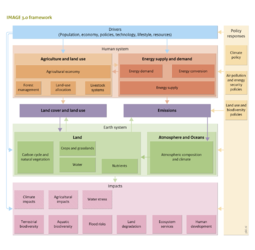
The Human system and the Earth system in IMAGE 3.0 are specified according to their key dynamics. The geographical resolution for socio-economic processes is 26 regions selected because of their relevance for global environmental and/or development issues, and the relatively high degree of coherence within these regions (Figure below). In the Earth system, land use and land-use changes are presented on a grid of 5x5 minutes, while the processes for plant growth, carbon and water cycles are modelled on a 30x30 minutes resolution. | The Human system and the Earth system in IMAGE 3.0 are specified according to their key dynamics. The geographical resolution for socio-economic processes is 26 regions selected because of their relevance for global environmental and/or development issues, and the relatively high degree of coherence within these regions (Figure below). In the Earth system, land use and land-use changes are presented on a grid of 5x5 minutes, while the processes for plant growth, carbon and water cycles are modelled on a 30x30 minutes resolution. | ||
{{DisplayFigureLeftOptimalTemplate|Region classification map}} | {{DisplayFigureLeftOptimalTemplate|Region classification map}} | ||
See [[Region classification]] for a detailed overview of the IMAGE 3.0 regions. | See [[Region classification map]] for a detailed overview of the IMAGE 3.0 regions. | ||
===Temporal scale=== | ===Temporal scale=== | ||
Revision as of 15:27, 16 May 2014
| Projects/Applications |
| Relevant overviews |
| Key publications |