Carbon cycle and natural vegetation/Description: Difference between revisions
Jump to navigation
Jump to search
No edit summary |
No edit summary |
||
| Line 25: | Line 25: | ||
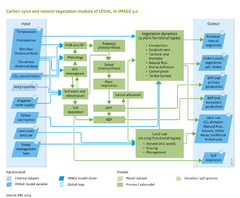
The [[LPJmL model]] has multiple links to other IMAGE components and uses IMAGE data on climate, atmospheric CO2 concentration, land use (including wood demand), and timber use and deforestation (cutting and burning). LPJmL supplies other IMAGE components with information on annual carbon fluxes, net CO2 exchange between biosphere and atmosphere, size of carbon pools, and biome classes (see [[Carbon_cycle_and_natural_vegetation|Table input/output]] at Introduction part ). | The [[LPJmL model]] has multiple links to other IMAGE components and uses IMAGE data on climate, atmospheric CO2 concentration, land use (including wood demand), and timber use and deforestation (cutting and burning). LPJmL supplies other IMAGE components with information on annual carbon fluxes, net CO2 exchange between biosphere and atmosphere, size of carbon pools, and biome classes (see [[Carbon_cycle_and_natural_vegetation|Table input/output]] at Introduction part ). | ||
LPJmL and IMAGE are linked via an interface and starts in the simulation year of 1970. Before 1970, vegetation and soil carbon pools need to be initialised. This is done by using LPJmL first in a 1000-year spin up to initialise the natural ecosystems and their carbon pools and fluxes, followed by a 390-year spin up, in which agricultural land is gradually expanded based on historical [[HYDE | LPJmL and IMAGE are linked via an interface and starts in the simulation year of 1970. Before 1970, vegetation and soil carbon pools need to be initialised. This is done by using LPJmL first in a 1000-year spin up to initialise the natural ecosystems and their carbon pools and fluxes, followed by a 390-year spin up, in which agricultural land is gradually expanded based on historical [[HYDE database|HYDE]] land-use data ([[Klein Goldewijk et al., 2011]]). The pool sizes of timber products for 1970 are based on literature estimates ([[Lauk et al., 2012]]). | ||
The linked IMAGE-LPJmL simulations start in 1970 with observed climate, followed by simulated climate from 2005 onwards (Component [[Atmospheric composition and climate]]). As the inter-annual variability in weather conditions is needed for the simulation of vegetation dynamics in IMAGE-LPJmL, smooth annual climate trends from IMAGE are superimposed with inter-annual variability fields, extracted from observed climate over the 1971–2000 period. To avoid repeating climate trends in these 30-year periods, annual anomalies are ordered at random before superimposition. | The linked IMAGE-LPJmL simulations start in 1970 with observed climate, followed by simulated climate from 2005 onwards (Component [[Atmospheric composition and climate]]). As the inter-annual variability in weather conditions is needed for the simulation of vegetation dynamics in IMAGE-LPJmL, smooth annual climate trends from IMAGE are superimposed with inter-annual variability fields, extracted from observed climate over the 1971–2000 period. To avoid repeating climate trends in these 30-year periods, annual anomalies are ordered at random before superimposition. | ||
}} | }} | ||
Revision as of 11:18, 20 May 2014
Parts of Carbon cycle and natural vegetation/Description
| Component is implemented in: |
|
| Related IMAGE components |
| Models/Databases |
| Key publications |
| References |