Carbon cycle and natural vegetation: Difference between revisions
Jump to navigation
Jump to search
No edit summary |
m (Text replace - "FrameworkElementType=model component" to "FrameworkElementType=state component ") |
||
| Line 5: | Line 5: | ||
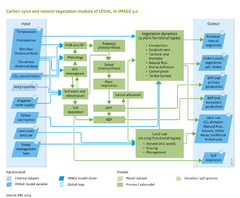
|InputVar=Temperature; Precipitation; Wet days; Cloudiness; CO2 concentration; Crop and grass fractions; Timber use fraction; Timber harvest; | |InputVar=Temperature; Precipitation; Wet days; Cloudiness; CO2 concentration; Crop and grass fractions; Timber use fraction; Timber harvest; | ||
|OutputVar=Potential natural vegetation; Biomes, ecoregions; Carbon pools and fluxes; NPP; NEP; Respiration; Terrestrial C balance; Carbon sequestration; | |OutputVar=Potential natural vegetation; Biomes, ecoregions; Carbon pools and fluxes; NPP; NEP; Respiration; Terrestrial C balance; Carbon sequestration; | ||
|FrameworkElementType= | |FrameworkElementType=state component | ||
|Description=Model intro | |Description=Model intro | ||
}} | }} | ||
[[HasOutputVar::Terrestrial C balance| ]] | [[HasOutputVar::Terrestrial C balance| ]] | ||
Revision as of 17:59, 26 November 2013
Parts of Carbon cycle and natural vegetation
| Component is implemented in: |
|
| Related IMAGE components |
| Models/Databases |
| Key publications |
| References |

Key policy issues
- What is the role of the terrestrial biosphere in the global carbon cycle, how will it change in time as a result of climate and land-use change?
- To what extent can the terrestrial biosphere contribute to reducing the accumulation of CO2 in the atmosphere and what are viable mechanisms?
- What opportunities exist to reduce land-use related carbon emissions (e.g. REDD) and even enhance the carbon uptake through the establishment of new forests.
- What are the contributions of land-use change, climate change and CO2 fertilization on the future carbon cycle and how can these be considered in climate policies?
Introduction