IMAGE framework: Difference between revisions
Jump to navigation
Jump to search
No edit summary |
No edit summary |
||
| Line 56: | Line 56: | ||
While economic models account for consistency between economic sectors, these models tend to treat the economy in terms of material flows, biochemical, physical and ecological processes in a stylised way, which limits their capacity to capture feedback mechanisms of the natural system. | While economic models account for consistency between economic sectors, these models tend to treat the economy in terms of material flows, biochemical, physical and ecological processes in a stylised way, which limits their capacity to capture feedback mechanisms of the natural system. | ||
====Geographic detail==== | |||
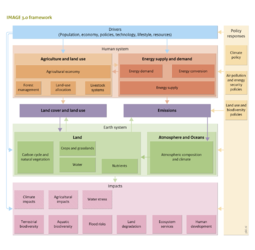
Finally, IAMs can also be distinguished by the level of geographic detail in land-based activities. To address geographical distribution of bio-geochemical and bio-geophysical processes in conjunction with human development, the IMAGE framework has been developed with a high level of geographic detail. IMAGE provides a relatively high level of detail on land-based processes, such as water, carbon and nutrient cycles, and derived indicators for biodiversity loss and flood risks, also in temporal and spatial resolution. | Finally, IAMs can also be distinguished by the level of geographic detail in land-based activities. To address geographical distribution of bio-geochemical and bio-geophysical processes in conjunction with human development, the IMAGE framework has been developed with a high level of geographic detail. IMAGE provides a relatively high level of detail on land-based processes, such as water, carbon and nutrient cycles, and derived indicators for biodiversity loss and flood risks, also in temporal and spatial resolution. | ||
|ComponentCode=IFI | |ComponentCode=IFI | ||
}} | }} | ||
Revision as of 13:57, 19 May 2014
| Projects/Applications |
| Models/Databases |
| Relevant overviews |
| References |