Impacts: Difference between revisions
No edit summary |
Oostenrijr (talk | contribs) No edit summary |
||
| (5 intermediate revisions by 3 users not shown) | |||
| Line 1: | Line 1: | ||
{{AggregatedComponentTemplate | {{AggregatedComponentTemplate | ||
|ComponentCode=I | |ComponentCode=I | ||
}}<div class="page_standard"> | |||
==Description of {{ROOTPAGENAME}}== | |||
IMAGE 3.0 modules for the Human system and Earth system are closely linked via multiple feedback mechanisms to form the core model of IMAGE 3.0. These modules produce output for two types of purposes. One purpose is to serve as input for other IMAGE modules and the other purpose is to serves as indicator for impacts. Many outputs serve both purposes, and many state variables of the IMAGE core modules constitute interesting impact indicators, such as land-use change, crop yields and climate parameters. | |||
The range of impacts has been extended beyond those that the core model can provide. As a result, additional impact modules have been developed and linked to the IMAGE core model through static data exchange. These impact modules can be used to address specific interests, and have been used in exploring a broad range of interactions between issues in sustainable development (see [[Dataflow_overview]] and [[Variable overview]]). | |||
A wide range of impact indicators originate from the modules in the core IMAGE model and those often reported in assessment studies are: | |||
* Energy supplied, traded, converted and consumed ([[Energy supply and demand]]) | |||
* Production of agricultural, animal and forestry products ([[Agricultural economy]]) | |||
* Forest cover, managed and unmanaged ([[Forest management]]) | |||
* Agricultural land use and land systems ([[Land-use allocation]]) | |||
* Livestock numbers and feed, fodder and grass intake ([[Livestock systems]]) | |||
* Land cover and land use ([[Land cover and land use]]) | |||
* Emission of greenhouse gases and air pollutants (Emissions) | |||
* Biomass and carbon stocks and flows ([[Carbon cycle and natural vegetation]]) | |||
* Potential and actual crop yields and grazing intensities ([[Crops and grass]]) | |||
* Renewable water availability, irrigation and water stress ([[Water]]) | |||
* Nutrient balances and their fate in soils and surface waters ([[Nutrients]]) | |||
* Atmospheric concentration and radiative forcing of greenhouse gases and other forcing agents ([[Atmospheric composition and climate]]) | |||
* Global average temperature; temperature and precipitation changes per grid cell; sea level rise ([[Atmospheric composition and climate]]) | |||
Further impact components available in the IMAGE 3.0 framework include [[Terrestrial biodiversity|Terrestrial ]] and [[Aquatic biodiversity]], [[Flood risks]], [[Land degradation]], [[Ecosystem services]], and [[Human development]]. | |||
</div> | |||
Latest revision as of 10:38, 17 November 2018
|
Composition of Impacts |
Description of Impacts
Description of Impacts
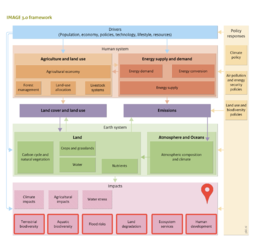
IMAGE 3.0 modules for the Human system and Earth system are closely linked via multiple feedback mechanisms to form the core model of IMAGE 3.0. These modules produce output for two types of purposes. One purpose is to serve as input for other IMAGE modules and the other purpose is to serves as indicator for impacts. Many outputs serve both purposes, and many state variables of the IMAGE core modules constitute interesting impact indicators, such as land-use change, crop yields and climate parameters.
The range of impacts has been extended beyond those that the core model can provide. As a result, additional impact modules have been developed and linked to the IMAGE core model through static data exchange. These impact modules can be used to address specific interests, and have been used in exploring a broad range of interactions between issues in sustainable development (see Dataflow_overview and Variable overview).
A wide range of impact indicators originate from the modules in the core IMAGE model and those often reported in assessment studies are:
- Energy supplied, traded, converted and consumed (Energy supply and demand)
- Production of agricultural, animal and forestry products (Agricultural economy)
- Forest cover, managed and unmanaged (Forest management)
- Agricultural land use and land systems (Land-use allocation)
- Livestock numbers and feed, fodder and grass intake (Livestock systems)
- Land cover and land use (Land cover and land use)
- Emission of greenhouse gases and air pollutants (Emissions)
- Biomass and carbon stocks and flows (Carbon cycle and natural vegetation)
- Potential and actual crop yields and grazing intensities (Crops and grass)
- Renewable water availability, irrigation and water stress (Water)
- Nutrient balances and their fate in soils and surface waters (Nutrients)
- Atmospheric concentration and radiative forcing of greenhouse gases and other forcing agents (Atmospheric composition and climate)
- Global average temperature; temperature and precipitation changes per grid cell; sea level rise (Atmospheric composition and climate)
Further impact components available in the IMAGE 3.0 framework include Terrestrial and Aquatic biodiversity, Flood risks, Land degradation, Ecosystem services, and Human development.