Land and biodiversity policies/Agricultural demand: Difference between revisions
No edit summary |
No edit summary |
||
| Line 8: | Line 8: | ||
{{PolicyInterventionSetTemplate | {{PolicyInterventionSetTemplate | ||
|Header=Shifts in consumption | |Header=Shifts in consumption | ||
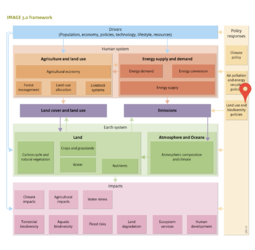
|Description=Interventions that induce shifts in consumption, for example to less meat-intensive diets, directly reduce the demand for animal products (Figure A). As a first order effect, this intervention reduces all upstream effects of production proportionally. Thus, they lead to less demand for animal products and less demand for feed crop production, which in turns requires less land and water and fewer nutrients – if all other settings in the crop production system remain the same – and thus decrease the impacts on biodiversity and climate (Figures B and C). However, as production systems are heterogeneous between and within regions, the effects may not be proportional. If, for example, extensively farmed agricultural areas, which typically have lower yields than other agricultural lands, are abandoned first, the area reduction will be larger. Likewise, if production shifts to regions with lower yields, less area reduction can be achieved | |Description={{DisplayFigureTemplate|Flowchart LBP}}{{DisplayFigureTemplate|Flowchart LBP II}} | ||
Interventions that induce shifts in consumption, for example to less meat-intensive diets, directly reduce the demand for animal products (Figure A). As a first order effect, this intervention reduces all upstream effects of production proportionally. Thus, they lead to less demand for animal products and less demand for feed crop production, which in turns requires less land and water and fewer nutrients – if all other settings in the crop production system remain the same – and thus decrease the impacts on biodiversity and climate (Figures B and C). However, as production systems are heterogeneous between and within regions, the effects may not be proportional. If, for example, extensively farmed agricultural areas, which typically have lower yields than other agricultural lands, are abandoned first, the area reduction will be larger. Likewise, if production shifts to regions with lower yields, less area reduction can be achieved. | |||
In addition to this heterogeneity effect, feedbacks in the economic system via price and trade may change the final impact of a demand intervention, compared to the first-order effect, especially if such interventions are applied in certain regions only. Lower demand for meat may reduce world market prices, and thus increase demand in other regions (Stehfest et al., 2013). Although this rebound effect would reduce the environmental benefits of the intervention, the impact on food security could be positive. | |||
|PISet=Changes in consumption and diet preferences; | |PISet=Changes in consumption and diet preferences; | ||
}} | }} | ||
Revision as of 09:26, 16 May 2014
Parts of Land and biodiversity policies/Agricultural demand
| Relevant overviews |
| References |
Shifts in consumption
Interventions that induce shifts in consumption, for example to less meat-intensive diets, directly reduce the demand for animal products (Figure A). As a first order effect, this intervention reduces all upstream effects of production proportionally. Thus, they lead to less demand for animal products and less demand for feed crop production, which in turns requires less land and water and fewer nutrients – if all other settings in the crop production system remain the same – and thus decrease the impacts on biodiversity and climate (Figures B and C). However, as production systems are heterogeneous between and within regions, the effects may not be proportional. If, for example, extensively farmed agricultural areas, which typically have lower yields than other agricultural lands, are abandoned first, the area reduction will be larger. Likewise, if production shifts to regions with lower yields, less area reduction can be achieved.
In addition to this heterogeneity effect, feedbacks in the economic system via price and trade may change the final impact of a demand intervention, compared to the first-order effect, especially if such interventions are applied in certain regions only. Lower demand for meat may reduce world market prices, and thus increase demand in other regions (Stehfest et al., 2013). Although this rebound effect would reduce the environmental benefits of the intervention, the impact on food security could be positive.
| Policy intervention | Description | Implemented in/affected component |
|---|---|---|
| Changes in consumption and diet preferences | Interventions that target consumption changes or changes in dietary preferences |
(*) Implementing component.
Managing demand for bio-energy crops
Policy interventions to manage the demand for bio-energy directly change the demand for bio-energy crops (figure A on the right). The environmental impacts, including land use, of such interventions depend on the mix of bio-energy crops, and stimulation of and/or restrictions on different bio-energy sources. Restricting the use of bio-energy directly affects the options and costs of climate policies (see also Climate policy and Air pollution and energy policies). It is important to note that the impact of reduced bio-energy demand on biodiversity can be twofold: on the one hand, more bio-energy use requires more land and therefore involves biodiversity loss (the same dynamics can be expected as described under 'shifts in consumption'). On the other hand, if policy on bio-energy use is not replaced by other (maybe more costly) climate policy measures, long-term climate change would be more severe, and thus biodiversity loss due to climate change could be greater, as well (Oorschot et al., 2010).
Several policies that affect demand have been analysed using the IMAGE model; for example, that on the reduction in the consumption of meat and dairy (PBL, 2011; Stehfest et al., 2013), restricted use of bio-energy, and reductions in losses and waste (PBL, 2010; PBL, 2012).
| Policy intervention | Description | Implemented in/affected component |
|---|---|---|
| Implementation of biofuel targets | Policies to enhance the use of biofuels, especially in the transport sector. In the Agricultural economy component only 'first generation' crops are taken into account. The policy is implemented as a budget-neutral policy from government perspective, e.g. a subsidy is implemented to achieve a certain share of biofuels in fuel production and an end-user tax is applied to counterfinance the implemented subsidy. | |
| Implementation of sustainability criteria in bio-energy production | Sustainability criteria that could become binding for dedicated bio-energy production, such as the restrictive use of water-scarce or degraded areas. |
(*) Implementing component.
Reducing food losses
Policies aimed at reducing food losses directly decrease the demand for food, in the case of waste on a consumer level, or, if post-harvest losses are reduced, decrease the amount of produce needed to fulfil the demand. This reduces the need for the production of food crops, fodder crops and animal products and therefore also reduces the environmental impacts of the production systems and the amount of agricultural land used. However, the same dynamics and second-order effects could be expected as those described under 'shifts in consumption'.
| Policy intervention | Description | Implemented in/affected component |
|---|---|---|
| Reduction of waste/losses | Reduction of losses in the agro-food chain and waste after consumption. |
(*) Implementing component.