Forest management: Difference between revisions
Jump to navigation
Jump to search
No edit summary |
No edit summary |
||
| Line 1: | Line 1: | ||
{{ComponentTemplate2 | {{ComponentTemplate2 | ||
|Status=Publishable | |Status=Publishable | ||
|ComponentCode=FM | |||
|MainComponent=Socio-economic system | |MainComponent=Socio-economic system | ||
|IMAGEComponent=Land use allocation; | |IMAGEComponent=Land use allocation; | ||
|Reference=Arets et al., 2011; Carle and Holmgren, 2008; Dell Lungo et al., 2006; FAO, 2010; Putz et al., 2012; ten Brink et al., 2010 | |Reference=Arets et al., 2011; Carle and Holmgren, 2008; Dell Lungo et al., 2006; FAO, 2010; Putz et al., 2012; ten Brink et al., 2010 | ||
|FrameworkElementType=model component | |||
|Description=The world’s total forest area in 2010 is estimated to be just over 40 million km<sup>2</sup>. | |Description=The world’s total forest area in 2010 is estimated to be just over 40 million km<sup>2</sup>. | ||
This forest resource is used by man for a multitude of purposes, such as timber, fuel, food, water and other forest related goods and services. None withstanding these value of forests, the area of forests still declines worldwide, with distinct differences over world regions. Deforestation has decreased in the last decade, bit still occurs in large parts of Latin-America, Africa and South East Asia, while net forest expansion takes place in regions like Europe and China. The main pressure driving deforestation processes is agricultural expansion. Next to forest area loss, degradation processes occur due to human use of forests. Managing the global forest resource in a more sustainable way may help to preserve forests, reduce or revert the degradation process, and simultaneously conserve the biodiversity and carbon store within forests (FAO, 2010). | This forest resource is used by man for a multitude of purposes, such as timber, fuel, food, water and other forest related goods and services. None withstanding these value of forests, the area of forests still declines worldwide, with distinct differences over world regions. Deforestation has decreased in the last decade, bit still occurs in large parts of Latin-America, Africa and South East Asia, while net forest expansion takes place in regions like Europe and China. The main pressure driving deforestation processes is agricultural expansion. Next to forest area loss, degradation processes occur due to human use of forests. Managing the global forest resource in a more sustainable way may help to preserve forests, reduce or revert the degradation process, and simultaneously conserve the biodiversity and carbon store within forests (FAO, 2010). | ||
| Line 20: | Line 22: | ||
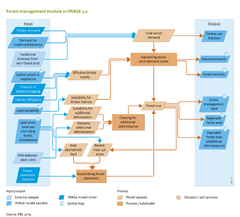
|CaptionText=Flow diagram of forest management | |CaptionText=Flow diagram of forest management | ||
|AltText=Component flow chart forest management | |AltText=Component flow chart forest management | ||
}} | }} | ||
Revision as of 14:37, 26 August 2013
Parts of Forest management
| Component is implemented in: |
| Components: |
| Related IMAGE components |
| Projects/Applications |
| Key publications |
| References |

Key policy issues
- How can management influence forest capacity to meet future demand for wood and other ecosystem services?
- What are the implications of forest management for pristine and managed forest areas, and on biomass and carbon stocks and fluxes of relevance for climate policy?
- What are the prospects for more sustainable forest management and the role of production in dedicated forest plantations?
Introduction
"model component" is not in the list (driver component, pressure component, interaction component, state component, impact component, response component) of allowed values for the "FrameworkElementType" property.