Forest management: Difference between revisions
Jump to navigation
Jump to search
No edit summary |
No edit summary |
||
| Line 1: | Line 1: | ||
{{ComponentTemplate2 | {{ComponentTemplate2 | ||
|IMAGEComponent=Scenario drivers; Agricultural systems; Natural vegetation and carbon cycle | |IMAGEComponent=Scenario drivers; Agricultural systems; Natural vegetation and carbon cycle | ||
|KeyReference=Arets, | |KeyReference=Arets et al, 2011 | ||
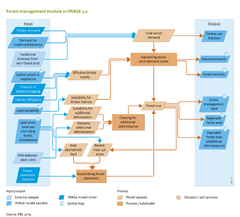
|InputVar=Timber demand; Demand for traditional biomass; Fraction of traditional biomass coming from non-forested land; Carbon pools in vegetation - grid; Fraction selective cut;; Harvest efficiency; Suitability; Land cover, land use - grid; | |InputVar=Timber demand; Demand for traditional biomass; Fraction of traditional biomass coming from non-forested land; Carbon pools in vegetation - grid; Fraction selective cut;; Harvest efficiency; Suitability; Land cover, land use - grid; | ||
FAO deforestation rates; Demand for Forest plantations; | FAO deforestation rates; Demand for Forest plantations; | ||
Revision as of 15:46, 25 March 2014
Parts of Forest management
| Component is implemented in: |
| Components: |
| Related IMAGE components |
| Projects/Applications |
| Key publications |
| References |

Key policy issues
- How can management influence forest capacity to meet future demand for wood and other ecosystem services?
- What are the implications of forest management for pristine and managed forest areas, and on biomass and carbon stocks and fluxes of relevance for climate policy?
- What are the prospects for more sustainable forest management and the role of production in dedicated forest plantations?