Forest management: Difference between revisions

From IMAGE
Jump to navigation Jump to search
No edit summary
No edit summary
Line 1: Line 1:
{{ComponentTemplate2
|Status=Publishable
|ComponentCode=FM
|ComponentCode=FM
|MainComponent=Socio-economic system
|MainComponent=Socio-economic system
|FrameworkElementType=model component
|Status=Publishable
|IMAGEComponent=Land use allocation-Agricultural systems;
|IMAGEComponent=Land use allocation-Agricultural systems;
|Reference=Arets et al., 2011; Carle and Holmgren, 2008; Dell Lungo et al., 2006; FAO, 2010; Putz et al., 2012; ten Brink et al., 2010
|InputVar=Land cover; Carbon pools and fluxes; Timber production from agricultural expansion; Demand for traditional biomass; Forestry drivers;
|InputVar=Land cover; Carbon pools and fluxes; Timber production from agricultural expansion; Demand for traditional biomass; Forestry drivers;
|OutputVar=Timber use fraction; Timber harvest; Forest land use types; Carbon pools and fluxes; Areas of regrowth forest;
|OutputVar=Timber use fraction; Timber harvest; Forest land use types; Carbon pools and fluxes; Areas of regrowth forest;
|FrameworkElementType=model component
|Description=Model intro
|Description=The world’s total forest area in 2010 is estimated to be just over 40 million km<sup>2</sup>.
This forest resource is used by man for a multitude of purposes, such as timber, fuel, food, water and other forest related goods and services. None withstanding these value of forests, the area of forests still declines worldwide, with distinct differences over world regions. Deforestation has decreased in the last decade, bit still occurs in large parts of Latin-America, Africa and South East Asia, while net forest expansion takes place in regions like Europe and China. The main pressure driving deforestation processes is agricultural expansion. Next to forest area loss, degradation processes occur due to human use of forests. Managing the global forest resource in a more sustainable way may help to preserve forests, reduce or revert the degradation process, and simultaneously conserve the biodiversity and carbon store within forests (FAO, 2010).
 
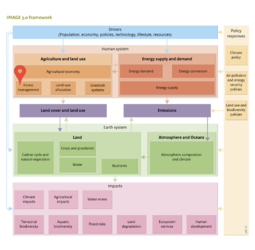
Therefore, forest management modelling is an important and integral part of the IMAGE 3.0 framework.
<h3>Forest management</h3>
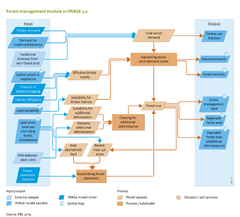
Several kinds of forest management systems, based on forest type, conservation, economics or a mixture, are in use  to meet the worldwide increasing demand of timber. They have different characteristics with respect to wood produced, the rotation cycle , the carbon content and biodiversity of forests.  The harvested timber is used in various ways, for instance as timber, pulp, paper, traditional fuel-wood and modern bio-energy. Each use has a different carbon cycle, resulting in a different amount of carbon capture in time for each type of wood use. In IMAGE three types of forest management systems are defined (see [[#Forest management systems]]) as a simplification of the whole range of possible management systems (Carle and Holmgren, 2008; Arets et al., 2011). The purpose of Sustainable Forest Management ([[hasAcronym::SFM]]) is to preserve the forests, their production capacity and biodiversity for future generations, and to counteract forest degradation processes. Several elements of SFM are included in policy options for this land-use type, mostly consisting of shifts in the preferred forestry management systems of IMAGE. 
<h3>Forest management systems</h3>
In IMAGE the following forest management systems are defined:
* Clearcut or clear felling is a management system in which all trees in an area are cut down and harvested, after which regrowth  will take place, either natural or assisted by management practices. This is applied often in temperate regions, where stands are often monocultures of specific endemic species. Such forests are often referred to as semi-natural.
* Selective logging is a system in which not all the trees in a specific area are felled, but only the economically most valuable trees. This system is used mostly in tropical forest with high heterogeneity and tree species diversity. Several improvements can be implemented within selective logging management collectively called Reduced Impact Logging ([[hasAcronym::RIL]]). Its objective is to reduce harvest damage, stimulate regrowth and maintain biodiversity (Putz et al., 2012). As such, the RIL system is a more ecological sustainable forestry system and is promoted under SFM-schemes.
* Wood plantation is the third system. Here specific fast-growing tree species, either endemic or exotic to the area, are planted and managed more intensively to maximize production and quality of the stems.  After the trees are harvested new ones are planted, and management is put in place . Wood plantations have generally a high productivity, and need to be established on available and suitable lands (Del Lungo et al., 2006). By providing more wood from less land, plantations may help in Sustainable Forest Management by reducing the pressures on natural forests (Carle and Homgren, 2008). However, to reap that benefit, additional safeguarding policies for the neighbouring semi-natural forest is needed, like set-aside practices for forest areas with specific functions (river corridors) or full protection of neighbouring areas identified as High Conservation Value sites.
<h3>Deforestation</h3>
In IMAGE deforestation is the conversion of forests into agricultural land caused by agriculture expansion (see component [[Land use allocation]]).  It may, however, also supply a relevant volume to the total wood removals. Counter-intuitive effects on land-use will occur when deforestation rates are slowed down, as the area of managed forest will increase to fulfill the same wood demand (ten Brink et al., 2010).
|Flowchart=ForestManagementModel.png
|Flowchart=ForestManagementModel.png
|CaptionText=Flow diagram of forest management
|CaptionText=Flow diagram of forest management
|AltText=Component flow chart forest management
|AltText=Component flow chart forest management
}}
}}

Revision as of 10:46, 20 November 2013

Key policy issues

  • How can management influence forest capacity to meet future demand for wood and other ecosystem services?
  • What are the implications of forest management for pristine and managed forest areas, and on biomass and carbon stocks and fluxes of relevance for climate policy?
  • What are the prospects for more sustainable forest management and the role of production in dedicated forest plantations?

Introduction

"model component" is not in the list (driver component, pressure component, interaction component, state component, impact component, response component) of allowed values for the "FrameworkElementType" property.