Livestock systems/Data uncertainties limitations: Difference between revisions
No edit summary |
No edit summary |
||
| (4 intermediate revisions by 2 users not shown) | |||
| Line 1: | Line 1: | ||
{{ComponentDataUncertaintyAndLimitationsTemplate | {{ComponentDataUncertaintyAndLimitationsTemplate | ||
|Reference=FAO, 2012a; Beusen et al., 2008; Bouwman et al., 2005; Seré and Steinfeld, 1996; | |Reference=FAO, 2012a; Beusen et al., 2008; Bouwman et al., 2005; Seré and Steinfeld, 1996; | ||
}}<div class="page_standard"> | |||
==Data, uncertainty and limitations== | |||
===Data=== | ===Data=== | ||
Historical livestock numbers, milk production per animal, off-take rates and carcass weights were obtained from [[FAO]] ([[FAO, 2012a]]). For ruminants, the production systems have been aggregated to two systems: pastoral, and mixed & landless production systems ([[Bouwman et al., 2005]]). For pigs and poultry three systems are distinguished. For pigs these are backyard, intermediate and intensive systems, and for poultry these are backyard, broiler and laying hens systems ([[Lassaletta et al., 2019]]). | |||
==Uncertainties== | ==Uncertainties== | ||
| Line 11: | Line 12: | ||
==Limitations== | ==Limitations== | ||
The key limitation in the current livestock module is that the ruminant livestock system have a soft linkage to the agricultural economy model MAGNET ([[Agricultural economy]]). Although [[MAGNET model|MAGNET]] has some representation of feed substitution and intensification as a result of land scarcity, and mimics the dynamics described here, there is no explicit representation of livestock systems | The key limitation in the current livestock module is that the ruminant livestock system have a soft linkage to the agricultural economy model MAGNET ([[Agricultural economy]]). Although [[MAGNET model|MAGNET]] has some representation of feed substitution and intensification as a result of land scarcity, and mimics the dynamics described here, there is no explicit representation of livestock systems and physically based feed compositions. | ||
</div> | |||
Latest revision as of 16:27, 26 November 2021
Parts of Livestock systems/Data uncertainties limitations
| Component is implemented in: |
| Components: |
| Related IMAGE components |
| Projects/Applications |
|
| Models/Databases |
| Key publications |
| References |

Data, uncertainty and limitations
Data
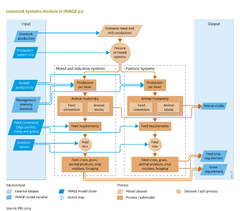
Historical livestock numbers, milk production per animal, off-take rates and carcass weights were obtained from FAO (FAO, 2012a). For ruminants, the production systems have been aggregated to two systems: pastoral, and mixed & landless production systems (Bouwman et al., 2005). For pigs and poultry three systems are distinguished. For pigs these are backyard, intermediate and intensive systems, and for poultry these are backyard, broiler and laying hens systems (Lassaletta et al., 2019).
Uncertainties
There are several uncertainties in the calculation of livestock production in the different systems for historical years and scenarios. The first uncertainty is the aggregation level on the scale of country or world region, which does not take account of underlying heterogeneity. The second uncertainty concerns the use of average data for carcass weight, off-take rate, and milk production for total livestock populations. In reality, livestock populations cover different age classes, and not all animals in a population are productive. Calculations, such as energy requirement for maintenance, are a non-linear function of body weight, and thus use of average values, may lead to distortion. The third uncertainty is associated with livestock numbers. Methodology and frequency of data collection (for example, by census) vary between countries, and are probably less certain for some developing countries than for industrialised countries. This uncertainty on livestock numbers affects not only the livestock module, but also all impact IMAGE modules that depend on livestock numbers, such as ammonia emissions (Beusen et al., 2008).
The main uncertainties in construction scenarios concern agricultural demand (Agricultural economy), the distribution of production over the two systems, and production characteristics per system, including feed requirements and feed types.
Limitations
The key limitation in the current livestock module is that the ruminant livestock system have a soft linkage to the agricultural economy model MAGNET (Agricultural economy). Although MAGNET has some representation of feed substitution and intensification as a result of land scarcity, and mimics the dynamics described here, there is no explicit representation of livestock systems and physically based feed compositions.