Land and biodiversity policies/Agricultural production system: Difference between revisions
m (Text replace - "Animal waste storage" to "Improved manure storage") |
No edit summary |
||
| Line 11: | Line 11: | ||
For the purpose of this section, we distinguish two interventions within the cropping system: ‘improved cropping systems or varieties’ and ‘crop and grass yields, cropping intensity’. Those two interventions are closely linked. Management in agriculture is a subtle interplay between the cultivar chosen, soil management, fertilizer and other input, and the timing and choice for each cultivation step. Here, the first interventions particularly focus on the reduction in – often negative – external effects other than the use of land. The second intervention targets concern the use of as few hectares as possible (address the amount of product per hectare). | For the purpose of this section, we distinguish two interventions within the cropping system: ‘improved cropping systems or varieties’ and ‘crop and grass yields, cropping intensity’. Those two interventions are closely linked. Management in agriculture is a subtle interplay between the cultivar chosen, soil management, fertilizer and other input, and the timing and choice for each cultivation step. Here, the first interventions particularly focus on the reduction in – often negative – external effects other than the use of land. The second intervention targets concern the use of as few hectares as possible (address the amount of product per hectare). | ||
|PISet= | |PISet=Improved manure storage; Integrated manure management; Changes in crop and livestock production systems; Intensification/extensification of livestock systems; Changes in feed ration; Improvement of feed conversion; Improved manure storage; Change in grazing intensity; Increased livestock productivity; | ||
}} | }} | ||
{{PolicyInterventionSetTemplate | {{PolicyInterventionSetTemplate | ||
|Header=Improving cropping systems or varieties | |Header=Improving cropping systems or varieties | ||
|Description=Improved cropping systems or varieties could increase the efficiency of the use of inputs, including water and nutrients. Combined with an application of those inputs that are well tuned to the requirements of the crops, this would lead to fewer nitrogen emissions or less water use per tonne of crop and, ultimately, would reduce the impacts on biodiversity and climate. Such improved management could also lead to higher yields (see below). Improved systems could imply a shift in the ratio between the factors used, such as labour, capital, land, fertilizer, water and other inputs. Therefore, the cost price of agricultural products may change, resulting in other market prices and a changed consumption. | |Description=Improved cropping systems or varieties could increase the efficiency of the use of inputs, including water and nutrients. Combined with an application of those inputs that are well tuned to the requirements of the crops, this would lead to fewer nitrogen emissions or less water use per tonne of crop and, ultimately, would reduce the impacts on biodiversity and climate. Such improved management could also lead to higher yields (see below). Improved systems could imply a shift in the ratio between the factors used, such as labour, capital, land, fertilizer, water and other inputs. Therefore, the cost price of agricultural products may change, resulting in other market prices and a changed consumption. | ||
|PISet= | |PISet=Changes in crop and livestock production systems; | ||
}} | }} | ||
{{PolicyInterventionSetTemplate | {{PolicyInterventionSetTemplate | ||
|Header=Crop and grass yields | |Header=Crop and grass yields | ||
|Description=Yield increase can be induced by other crop varieties; for example, by increasing the potential yield or better management (thus, closing the yield gap). One should keep in mind that other – more suitable – crop varieties often also need other types of management in order to give higher yields. | |Description=Yield increase can be induced by other crop varieties; for example, by increasing the potential yield or better management (thus, closing the yield gap). One should keep in mind that other – more suitable – crop varieties often also need other types of management in order to give higher yields. | ||
|PISet= | |PISet=Improved irrigation efficiency; Improved rainwater management; Integrated manure management; Changes in crop and livestock production systems; | ||
}} | }} | ||
{{PolicyInterventionSetTemplate | {{PolicyInterventionSetTemplate | ||
|Header=Cropping intensity | |Header=Cropping intensity | ||
|Description=Cropping intensity can be increased by multiple cropping (more harvests per year), which depends on climatic circumstances, or by decreasing the area that is left fallow. Both interventions would decrease the required production area for all crops, but it could also, locally, increase the environmental impacts per hectare of crops. Where lower area requirements decrease biodiversity and climate impacts, the environmental impacts per hectare could increase them again. Thus, to decrease biodiversity loss, yield increases should go hand in hand with system changes, which may result in fewer negative external impacts, as described for the intervention above. Increased cropping intensity increases the risk of soil degradation if cropping rotations or soil management are not adapted, as well. | |Description=Cropping intensity can be increased by multiple cropping (more harvests per year), which depends on climatic circumstances, or by decreasing the area that is left fallow. Both interventions would decrease the required production area for all crops, but it could also, locally, increase the environmental impacts per hectare of crops. Where lower area requirements decrease biodiversity and climate impacts, the environmental impacts per hectare could increase them again. Thus, to decrease biodiversity loss, yield increases should go hand in hand with system changes, which may result in fewer negative external impacts, as described for the intervention above. Increased cropping intensity increases the risk of soil degradation if cropping rotations or soil management are not adapted, as well. | ||
|PISet= | |PISet=Changes in crop and livestock production systems; | ||
}} | }} | ||
{{ContentPartsTemplate}} | {{ContentPartsTemplate}} | ||
[[Page has default form::PolicyResponsePartForm| ]] | [[Page has default form::PolicyResponsePartForm| ]] | ||
Revision as of 14:58, 2 April 2014
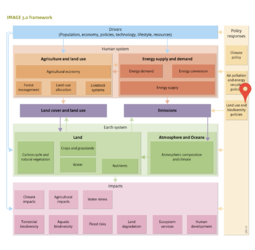
Parts of Land and biodiversity policies/Agricultural production system
| Relevant overviews |
Improving livestock systems
Interventions that improve livestock systems include the use of other breeds that have higher feed conversion rates, which may require another ratio of feed composites, or produce less manure. Changes in the feed conversion or composition of feed, for example, the ratio between grazing and feed crop feeding, influence the demand for grazing areas and crop areas, and therefore changing these systems will result in other environmental impacts and other patterns of agricultural land use. The amounts and quality of manure affect nitrogen emission levels and thus also both nutrient balances and climate-change impacts. In addition, biodiversity will be affected via nitrogen emissions. As a positive side effect, different production systems can have positive impacts on animal welfare, too. However, in most cases, higher animal welfare standards involve more input per unit of production (PBL, 2011). The way manure is stored and applied to the land also differs across livestock systems, and influences crop yields and emission levels. A secondary impact of increasing feed efficiencies could be that of cost reductions, leading to a similar feedback effect as described for changes in demand.
For the purpose of this section, we distinguish two interventions within the cropping system: ‘improved cropping systems or varieties’ and ‘crop and grass yields, cropping intensity’. Those two interventions are closely linked. Management in agriculture is a subtle interplay between the cultivar chosen, soil management, fertilizer and other input, and the timing and choice for each cultivation step. Here, the first interventions particularly focus on the reduction in – often negative – external effects other than the use of land. The second intervention targets concern the use of as few hectares as possible (address the amount of product per hectare).
| Policy intervention | Description | Implemented in/affected component |
|---|---|---|
| Improved manure storage | Improved manure storage systems (ST), considering 20% lower NH3 emissions from animal housing and storage systems. |
|
| Integrated manure management | Better integration of manure in crop production systems. This consists of recycling of manure that under the baseline scenario ends up outside the agricultural system (e.g. manure used as fuel), in crop systems to substitute fertiliser. In addition, there is improved integration of animal manure in crop systems, particularly in industrialised countries. |
|
| Changes in crop and livestock production systems | General changes in crop and livestock production systems, e.g. more efficient production methods to create higher production per unit of input, or other systems like organic farming | |
| Intensification/extensification of livestock systems | A change in the distribution of the production over pastoral and mixed systems; usually to a larger share of the production in mixed systems, which inherently changes the overall feed conversion ratios of ruminants. | |
| Changes in feed ration | Change in the share of grass in the feed rations of cattle, sheep and goats, usually a decrease, meaning grass will be substituted by feed crops and the livestock system will be more intensive. | |
| Improvement of feed conversion | Improvement of feed conversion ratio of small ruminants, such as sheep and goats. This means other breeds will be used that need less grass to produce the same amount of meat. | |
| Improved manure storage | Improved manure storage systems (ST), considering 20% lower NH3 emissions from animal housing and storage systems. |
|
| Change in grazing intensity | Change in grazing intensity, usually more intensive. This would require better management of grasslands, including for example the use of grass-clover mixtures and fertilisers, bringing the length of the grazing season in tune with the period of grass production, and rotations. | |
| Increased livestock productivity | A change in production characteristics, such as milk production per animal, carcass weight and off-take rates, which will also have an impact on the feed conversion ratio; in general, this will be lower in more productive animals |
(*) Implementing component.
Improving cropping systems or varieties
Improved cropping systems or varieties could increase the efficiency of the use of inputs, including water and nutrients. Combined with an application of those inputs that are well tuned to the requirements of the crops, this would lead to fewer nitrogen emissions or less water use per tonne of crop and, ultimately, would reduce the impacts on biodiversity and climate. Such improved management could also lead to higher yields (see below). Improved systems could imply a shift in the ratio between the factors used, such as labour, capital, land, fertilizer, water and other inputs. Therefore, the cost price of agricultural products may change, resulting in other market prices and a changed consumption.
| Policy intervention | Description | Implemented in/affected component |
|---|---|---|
| Changes in crop and livestock production systems | General changes in crop and livestock production systems, e.g. more efficient production methods to create higher production per unit of input, or other systems like organic farming |
(*) Implementing component.
Crop and grass yields
Yield increase can be induced by other crop varieties; for example, by increasing the potential yield or better management (thus, closing the yield gap). One should keep in mind that other – more suitable – crop varieties often also need other types of management in order to give higher yields.
| Policy intervention | Description | Implemented in/affected component |
|---|---|---|
| Improved irrigation efficiency | Improved irrigation efficiency assumes an increase in the irrigation project efficiency and irrigation conveyance efficiency. |
|
| Improved rainwater management | Improved rainwater management assumes a decrease in the evaporative losses from rainfed agriculture and the creation of small scale reservoirs to harvest rainwater during the wet period and use it during a dryer period. Both measures lead to more efficient use of water and increased yields on rainfed fields. |
|
| Integrated manure management | Better integration of manure in crop production systems. This consists of recycling of manure that under the baseline scenario ends up outside the agricultural system (e.g. manure used as fuel), in crop systems to substitute fertiliser. In addition, there is improved integration of animal manure in crop systems, particularly in industrialised countries. |
|
| Changes in crop and livestock production systems | General changes in crop and livestock production systems, e.g. more efficient production methods to create higher production per unit of input, or other systems like organic farming |
(*) Implementing component.
Cropping intensity
Cropping intensity can be increased by multiple cropping (more harvests per year), which depends on climatic circumstances, or by decreasing the area that is left fallow. Both interventions would decrease the required production area for all crops, but it could also, locally, increase the environmental impacts per hectare of crops. Where lower area requirements decrease biodiversity and climate impacts, the environmental impacts per hectare could increase them again. Thus, to decrease biodiversity loss, yield increases should go hand in hand with system changes, which may result in fewer negative external impacts, as described for the intervention above. Increased cropping intensity increases the risk of soil degradation if cropping rotations or soil management are not adapted, as well.
| Policy intervention | Description | Implemented in/affected component |
|---|---|---|
| Changes in crop and livestock production systems | General changes in crop and livestock production systems, e.g. more efficient production methods to create higher production per unit of input, or other systems like organic farming |
(*) Implementing component.