Livestock systems/Policy issues: Difference between revisions
Jump to navigation
Jump to search
No edit summary |
No edit summary |
||
| Line 8: | Line 8: | ||
*more intensive grazing will require improved grassland management, including use of grass-clover mixes and fertilisers, and aligning the grazing season with grass production and rotations. | *more intensive grazing will require improved grassland management, including use of grass-clover mixes and fertilisers, and aligning the grazing season with grass production and rotations. | ||
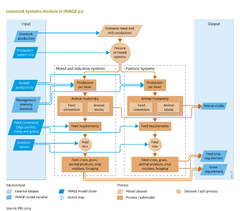
All such interventions have been combined in the Global Technology (GT) scenario of the Rio+20 study, resulting in more production in mixed systems (+10%), higher carcass weights (+10%), higher off-take rates (+10%), more efficient feed conversion by sheep and goats (+10%), more feed crops (15%) and higher grazing intensities (15%). This package leads to a considerable reduction in grassland area of about 15% compared to the baseline scenario for 2050 (see figure below), leaving more area for biodiversity recovery. | All such interventions have been combined in the Global Technology (GT) scenario of the [[Roads from Rio+20 (2012) project |Rio+20]] study, resulting in more production in mixed systems (+10%), higher carcass weights (+10%), higher off-take rates (+10%), more efficient feed conversion by sheep and goats (+10%), more feed crops (15%) and higher grazing intensities (15%). This package leads to a considerable reduction in grassland area of about 15% compared to the baseline scenario for 2050 (see figure below), leaving more area for biodiversity recovery. | ||
}} | }} | ||
Revision as of 17:30, 5 May 2014
Parts of Livestock systems/Policy issues
| Component is implemented in: |
| Components: |
| Related IMAGE components |
| Projects/Applications |
|
| Models/Databases |
| Key publications |