Livestock systems/Description: Difference between revisions
Jump to navigation
Jump to search
m (Text replace - "Agricultural economy and forestry" to "Agricultural economy") |
m (Text replace - "Agricultural systems" to "Land-use allocation") |
||
| Line 14: | Line 14: | ||
==Cropland and grassland required== | ==Cropland and grassland required== | ||
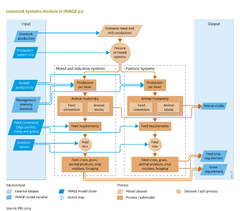
Areas for feed crop production and grass are calculated on the basis of feed crop and grass requirements ([[ | Areas for feed crop production and grass are calculated on the basis of feed crop and grass requirements ([[Land-use allocation]]), which are calculated from total feed requirement and diet composition (feed rations, see below). | ||
Composition of animal feed | Composition of animal feed | ||
IMAGE distinguishes five feed categories: | IMAGE distinguishes five feed categories: | ||
| Line 25: | Line 25: | ||
In pastoral ruminant production systems, the feed is almost entirely grass except in developing regions where foraging constitutes a larger but variable proportion of the total feed. Pigs and poultry are fed feed crops and by-products, crop residues and fodder. Since these animals are mainly farmed in mixed systems, the contribution of feed crops and residues to the total feed in these systems is much higher than in pastoral systems. | In pastoral ruminant production systems, the feed is almost entirely grass except in developing regions where foraging constitutes a larger but variable proportion of the total feed. Pigs and poultry are fed feed crops and by-products, crop residues and fodder. Since these animals are mainly farmed in mixed systems, the contribution of feed crops and residues to the total feed in these systems is much higher than in pastoral systems. | ||
The required feed crop production per animal is calculated from feed rations, and this information is incorporated into the agro-economic model ([[Agricultural economy]]). The proportion of grass in feed rations determines total grass consumption, which is used to compute the grassland area per world region, based on grazing intensity ([[Agricultural economy]] and [[ | The required feed crop production per animal is calculated from feed rations, and this information is incorporated into the agro-economic model ([[Agricultural economy]]). The proportion of grass in feed rations determines total grass consumption, which is used to compute the grassland area per world region, based on grazing intensity ([[Agricultural economy]] and [[Land-use allocation]]). | ||
==Scenario definition== | ==Scenario definition== | ||
A scenario includes assumptions on milk production per animal for dairy cattle, carcass weight and off-take rate for beef cattle, pigs, poultry, sheep and goats, and feed conversion rates (FCR) for pigs, poultry, sheep and goats. The changes in these parameters are generally based on the scenario, and on the economic growth scenario. | A scenario includes assumptions on milk production per animal for dairy cattle, carcass weight and off-take rate for beef cattle, pigs, poultry, sheep and goats, and feed conversion rates (FCR) for pigs, poultry, sheep and goats. The changes in these parameters are generally based on the scenario, and on the economic growth scenario. | ||
}} | }} | ||
Revision as of 18:39, 16 May 2014
Parts of Livestock systems/Description
| Component is implemented in: |
| Components: |
| Related IMAGE components |
| Projects/Applications |
|
| Models/Databases |
| Key publications |
| References |