Livestock systems/Data uncertainties limitations: Difference between revisions
Jump to navigation
Jump to search
m (RinekeOostenrijk moved page Livestock/Data uncertainties limitations to Livestock systems/Data uncertainties limitations without leaving a redirect) |
No edit summary |
||
| Line 1: | Line 1: | ||
{{ComponentDataUncertaintyAndLimitationsTemplate | {{ComponentDataUncertaintyAndLimitationsTemplate | ||
|Reference=FAO, 2012a; Beusen et al., 2008; Bouwman et al., 2005; Seré and Steinfeld, 1996; | |Reference=FAO, 2012a; Beusen et al., 2008; Bouwman et al., 2005; Seré and Steinfeld, 1996; | ||
|Description=<h2>Data</h2> | |Description=<h2>Data, uncertainties and limitations</h2> | ||
Data | ===Data=== | ||
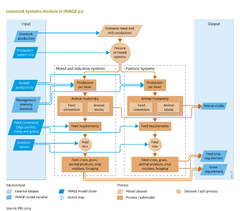
Livestock numbers, milk production per animal, off-take rates and carcass weights for the 1970–2005 period were obtained from [[FAO]] ([[FAO, 2012a]]). Various animal production systems, and the total livestock population and production have been defined in recent FAO publications ([[Seré and Steinfeld, 1996]]). For ruminants, these production systems include pastoral, mixed and landless production in various agro-ecological zones. These data have been aggregated to two systems: pastoral, and mixed & landless production systems, and disaggregated from seven world regions to the 24 world regions in the IMAGE model ([[Bouwman et al., 2005]]). [[Seré and Steinfeld, 1996]] also provided data on the growth in livestock populations and on production in each production system. | |||
==Uncertainties== | ==Uncertainties== | ||
| Line 10: | Line 11: | ||
==Limitations== | ==Limitations== | ||
The key limitation in the current livestock module is that the ruminant livestock system have a soft linkage to the agricultural economy model MAGNET ([[Agricultural economy]]). Although [[MAGNET model|MAGNET]] has some representation of feed substitution and intensification as a result of land scarcity, and mimics the dynamics described here, there is no explicit representation of livestock systems, and physically based feed compositions. | The key limitation in the current livestock module is that the ruminant livestock system have a soft linkage to the agricultural economy model MAGNET ([[Agricultural economy]]). Although [[MAGNET model|MAGNET]] has some representation of feed substitution and intensification as a result of land scarcity, and mimics the dynamics described here, there is no explicit representation of livestock systems, and physically based feed compositions. | ||
}} | }} | ||
Revision as of 13:18, 21 May 2014
Parts of Livestock systems/Data uncertainties limitations
| Component is implemented in: |
| Components: |
| Related IMAGE components |
| Projects/Applications |
|
| Models/Databases |
| Key publications |
| References |