Agricultural economy: Difference between revisions
Jump to navigation
Jump to search
No edit summary |
No edit summary |
||
| Line 6: | Line 6: | ||
|Application=Eururalis; Millennium Ecosystem Assessment; Global Environmental Outlooks; | |Application=Eururalis; Millennium Ecosystem Assessment; Global Environmental Outlooks; | ||
|IMAGEComponent=Land use allocation-Agricultural systems; | |IMAGEComponent=Land use allocation-Agricultural systems; | ||
|ExternalModel=EFIGTM | |ExternalModel=EFIGTM; | ||
|KeyReference=Van Meijl et al., 2006; Woltjer, 2011; Rosegrant et al., 2009; Eickhout et al., 2009; Stehfest, 2013; | |KeyReference=Van Meijl et al., 2006; Woltjer, 2011; Rosegrant et al., 2009; Eickhout et al., 2009; Stehfest, 2013; | ||
|Reference=Stehfest, 2013; | |Reference=Stehfest, 2013; | ||
| Line 12: | Line 12: | ||
|OutputVar=Crop production; Management intensity crops; Management intensity livestock; Timber demand; Food availability per capita; Commodity price; Livestock production; | |OutputVar=Crop production; Management intensity crops; Management intensity livestock; Timber demand; Food availability per capita; Commodity price; Livestock production; | ||
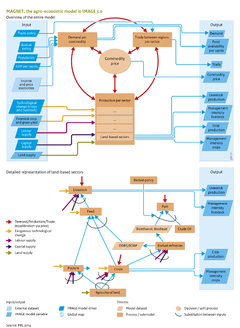
|Description=Expansion of agriculture is one of the most important and visible alternations of the natural environment, leading to greenhouse gas emissions, loss of biodiversity and ecosystem services, and nutrient imbalances. It is driven by the production of food, feed for livestock, fibers and other products, bio-energy and timber, resulting from domestic demand and trade in these products. In IMAGE, demand and trade are based on external projections of demographic and economic development, technological change, policy scenarios, and resource availability. Changes in income and population lead to a changing demand for agricultural commodities. This induces a change in the supply, which also depends on the resource availability and the efficiency of natural resource use. This efficiency can change as a result of technological change and substitution between production factors. | |Description=Expansion of agriculture is one of the most important and visible alternations of the natural environment, leading to greenhouse gas emissions, loss of biodiversity and ecosystem services, and nutrient imbalances. It is driven by the production of food, feed for livestock, fibers and other products, bio-energy and timber, resulting from domestic demand and trade in these products. In IMAGE, demand and trade are based on external projections of demographic and economic development, technological change, policy scenarios, and resource availability. Changes in income and population lead to a changing demand for agricultural commodities. This induces a change in the supply, which also depends on the resource availability and the efficiency of natural resource use. This efficiency can change as a result of technological change and substitution between production factors. | ||
<h3>Agricultural economy</h3> | <h3>Agricultural economy</h3> | ||
Revision as of 17:45, 1 November 2013
Parts of Agricultural economy
| Component is implemented in: |
|
| Related IMAGE components |
| Projects/Applications |
| Key publications |
| References |

Key policy issues
- What is the area of cropland and grassland required to support future food demand?
- What are the policy options to reduce agricultural land use and to safeguard global biodiversity, while ensuring food security?
- How can the implications of biofuels for land use and greenhouse gases be managed sustainably?
Introduction
"model component" is not in the list (driver component, pressure component, interaction component, state component, impact component, response component) of allowed values for the "FrameworkElementType" property.