Agricultural economy: Difference between revisions
Jump to navigation
Jump to search
No edit summary |
No edit summary |
||
| Line 6: | Line 6: | ||
|Application=Eururalis; Millennium Ecosystem Assessment; Global Environmental Outlooks; | |Application=Eururalis; Millennium Ecosystem Assessment; Global Environmental Outlooks; | ||
|IMAGEComponent=Land use allocation-Agricultural systems; | |IMAGEComponent=Land use allocation-Agricultural systems; | ||
|ExternalModel=EFIGTM; | |ExternalModel=EFIGTM; | ||
|KeyReference=Van Meijl et al., 2006; Woltjer, 2011; Rosegrant et al., 2009; Eickhout et al., 2009; Stehfest, 2013; | |KeyReference=Van Meijl et al., 2006; Woltjer, 2011; Rosegrant et al., 2009; Eickhout et al., 2009; Stehfest, 2013; | ||
|Reference=Stehfest, 2013; | |Reference=Stehfest, 2013; | ||
| Line 14: | Line 14: | ||
<h3>Agricultural economy</h3> | <h3>Agricultural economy</h3> | ||
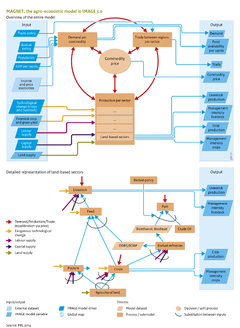
Agricultural production is distributed across regions via trade, depending on their historic trade balances and their competitiveness. In IMAGE, two different agro-economic models, [[IMPACT model| IMPACT]] and [[MAGNET model| MAGNET]] (formerly LEITAP) can be applied via a [[Media:IMAGE-MAGNET coupling.png|soft model linkage]] to model the future development of the agricultural economy. The model selection depends on the specific questions to be addressed. While IMPACT has been used for developing alternative baselines in international assessments like [[Millennium Ecosystem Assessment]] and [[ | Agricultural production is distributed across regions via trade, depending on their historic trade balances and their competitiveness. In IMAGE, two different agro-economic models, [[IMPACT model| IMPACT]] and [[MAGNET model| MAGNET]] (formerly LEITAP) can be applied via a [[Media:IMAGE-MAGNET coupling.png|soft model linkage]] to model the future development of the agricultural economy. The model selection depends on the specific questions to be addressed. While IMPACT has been used for developing alternative baselines in international assessments like [[Millennium Ecosystem Assessment]] and [[UNEP]]s [[Global Environmental Outlooks]] , the MAGNET model has been applied more often to study specific policy options at the global and regional scale, and for European assessments such as [[Eururalis]]. The coupling between these two models and IMAGE is similar, and a detailed comparison between the two models is available elsewhere ([[Stehfest, 2013]]). Here, the focus is on MAGNET(see [[Media:Flow_diagram_MAGNET.png|Flow diagram]]). | ||
<h3>Agricultural forestry</h3> | <h3>Agricultural forestry</h3> | ||
The demand for forest products can be derived in IMAGE from several sources. In the most simple case via a simple relation with GDP, or, preferably, prescribed from specific forest demand models like [[EFIGTM]]. In the future, full competition of forestry with other land uses can be accounted for by using the forestry component of MAGNET (not available yet). Other land use changes, like the expansion of infrastructure, which do not require inter-regional connections, are described in the [[Land_use_allocation-Agricultural_systems]] component. | The demand for forest products can be derived in IMAGE from several sources. In the most simple case via a simple relation with GDP, or, preferably, prescribed from specific forest demand models like [[EFIGTM]]. In the future, full competition of forestry with other land uses can be accounted for by using the forestry component of MAGNET (not available yet). Other land use changes, like the expansion of infrastructure, which do not require inter-regional connections, are described in the [[Land_use_allocation-Agricultural_systems]] component. | ||
}} | }} | ||
Revision as of 16:42, 15 November 2013
Parts of Agricultural economy
| Component is implemented in: |
|
| Related IMAGE components |
| Projects/Applications |
| Key publications |
| References |

Key policy issues
- What is the area of cropland and grassland required to support future food demand?
- What are the policy options to reduce agricultural land use and to safeguard global biodiversity, while ensuring food security?
- How can the implications of biofuels for land use and greenhouse gases be managed sustainably?
Introduction
"model component" is not in the list (driver component, pressure component, interaction component, state component, impact component, response component) of allowed values for the "FrameworkElementType" property.