Agricultural economy: Difference between revisions
No edit summary |
No edit summary |
||
| (104 intermediate revisions by 9 users not shown) | |||
| Line 1: | Line 1: | ||
{{ComponentTemplate2 | {{ComponentTemplate2 | ||
|Application=AgMIP and ISI-MIP project;The Protein Puzzle (2011) project;Rethinking Biodiversity Strategies (2010) project;Roads from Rio+20 (2012) project;Global Land Outlook 1;Global Land Outlook 2;FOODSECURE;Sim4Nexus;LUC4C;Shared Socioeconomic Pathways - SSP (2014) project | |||
|IMAGEComponent=Drivers;Land-use allocation | |||
|KeyReference=Stehfest et al., 2013;Woltjer et al., 2014;Von Lampe et al., 2014;Bijl et al., 2017 | |||
|Reference=Woltjer et al., 2011;Kallio et al., 2004;Carpenter et al., 2006;Van Vuuren et al., 2018 | |||
|InputVar=Population;GDP per capita;Capital supply;Labour supply;Trade policy;Biofuel policy;Land supply;Potential crop and grass yield - grid;Technological change (crops and livestocks) | |||
|Parameter=Income and price elasticities | |||
|OutputVar=Management intensity crops;Management intensity livestock;Food availability per capita;Commodity price;Livestock production;Crop production;Demand (all commodities);Trade (all commodities) | |||
|ComponentCode=AEF | |ComponentCode=AEF | ||
| | |AggregatedComponent=Agriculture and land use | ||
|FrameworkElementType= | |FrameworkElementType=pressure component | ||
}} | |||
<div class="page_standard"> | |||
As a result of the growing world population and higher per capita consumption, the production of food, feed, fibers, and other products, such as bioenergy and timber, will need to increase rapidly in the coming decades. Even with the expected improvements in agricultural yields and efficiency, there will be increasing demand for more agricultural land. However, the expansion of agricultural land will lead to deforestation and increases in greenhouse gas emissions, loss of biodiversity and ecosystem services, and nutrient imbalances. To reduce these environmental impacts, a further increase in agricultural yields is needed, together with other options such as reduced food losses, dietary changes, improved livestock systems, and better nutrient management. | |||
In the IMAGE framework, the future development of the agricultural economy can be calculated using the agro-economic model [[MAGNET model|MAGNET]] ([[Woltjer et al., 2014]]). MAGNET is a computable general equilibrium ({{abbrTemplate|CGE}}) model that is connected via a soft link to the core model of IMAGE. Demographic changes and changes in income are the primary driving factors of the MAGNET model and lead to changing demand for all commodities, including agricultural commodities. In response to this change in demand, agricultural production is increasing, and the model also considers changing prices of production factors, resource availability, and technological progress. In MAGNET, agricultural production supplies domestic markets, and other countries and regions are supplied via international trade, depending on historical trade balances, competitiveness (relative price developments), transport costs, and trade policies. MAGNET uses information from IMAGE on land availability and suitability and changes in crop yields due to climate change and agricultural expansion on heterogeneous land areas. The results from MAGNET on agricultural production, grassland area, and endogenous yield efficiency (i.e. management factor) changes are used in IMAGE to calculate spatially explicit land-use change and the environmental impacts on carbon, nutrient and water cycles, biodiversity, and climate. | |||
Although MAGNET is the standard agro-economic model used with IMAGE, other models can be linked with IMAGE. For example, the [[IMPACT model]] was used with IMAGE in the [[Millennium Ecosystem Assessment - MA (2005) project|Millennium Ecosystem Assessment]] ([[Carpenter et al., 2006]]), and in a [[The Protein Puzzle (2011) project|PBL study on protein supply]], both the [[MAGNET model|MAGNET]] and the [[IMPACT model|IMPACT]] model were used to study the same set of scenarios. This allowed a systematic comparison between IMPACT and MAGNET ([[Stehfest et al., 2013]]). In a more recent study [[van Vuuren et al., 2018]] the Food Demand Model ([[Bijl et al., 2017]]) was used for projections of food demand with various diets. This is a physically oriented, statistical model using based on historical relations between income, food consumption, and regional differences, which is also an integrated part of the IMAGE framework. | |||
Other land-use changes, such as infrastructure expansion, which do not require interregional links, are described in the [[Land-use allocation|land-use allocation]] model). Demand for timber is described on the [[Forest management|forest management]] page. | |||
}} | {{InputOutputParameterTemplate}} | ||
</div> | |||
Latest revision as of 13:55, 7 November 2022
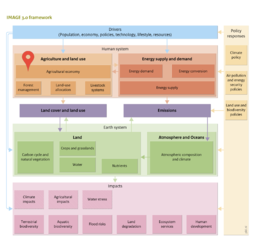
Parts of Agricultural economy
| Component is implemented in: |
|
| Related IMAGE components |
| Projects/Applications |
| Key publications |
| References |

Key policy issues
- What is the area of cropland and grassland required to support future food demand?
- What are the policy options to reduce agricultural land use and to safeguard global biodiversity, while ensuring food security?
- How can the implications of biofuels for land use and greenhouse gases be managed sustainably?
Introduction
As a result of the growing world population and higher per capita consumption, the production of food, feed, fibers, and other products, such as bioenergy and timber, will need to increase rapidly in the coming decades. Even with the expected improvements in agricultural yields and efficiency, there will be increasing demand for more agricultural land. However, the expansion of agricultural land will lead to deforestation and increases in greenhouse gas emissions, loss of biodiversity and ecosystem services, and nutrient imbalances. To reduce these environmental impacts, a further increase in agricultural yields is needed, together with other options such as reduced food losses, dietary changes, improved livestock systems, and better nutrient management.
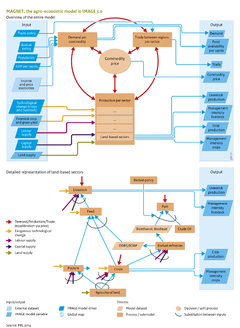
In the IMAGE framework, the future development of the agricultural economy can be calculated using the agro-economic model MAGNET (Woltjer et al., 2014). MAGNET is a computable general equilibrium (CGE) model that is connected via a soft link to the core model of IMAGE. Demographic changes and changes in income are the primary driving factors of the MAGNET model and lead to changing demand for all commodities, including agricultural commodities. In response to this change in demand, agricultural production is increasing, and the model also considers changing prices of production factors, resource availability, and technological progress. In MAGNET, agricultural production supplies domestic markets, and other countries and regions are supplied via international trade, depending on historical trade balances, competitiveness (relative price developments), transport costs, and trade policies. MAGNET uses information from IMAGE on land availability and suitability and changes in crop yields due to climate change and agricultural expansion on heterogeneous land areas. The results from MAGNET on agricultural production, grassland area, and endogenous yield efficiency (i.e. management factor) changes are used in IMAGE to calculate spatially explicit land-use change and the environmental impacts on carbon, nutrient and water cycles, biodiversity, and climate.
Although MAGNET is the standard agro-economic model used with IMAGE, other models can be linked with IMAGE. For example, the IMPACT model was used with IMAGE in the Millennium Ecosystem Assessment (Carpenter et al., 2006), and in a PBL study on protein supply, both the MAGNET and the IMPACT model were used to study the same set of scenarios. This allowed a systematic comparison between IMPACT and MAGNET (Stehfest et al., 2013). In a more recent study van Vuuren et al., 2018 the Food Demand Model (Bijl et al., 2017) was used for projections of food demand with various diets. This is a physically oriented, statistical model using based on historical relations between income, food consumption, and regional differences, which is also an integrated part of the IMAGE framework.
Other land-use changes, such as infrastructure expansion, which do not require interregional links, are described in the land-use allocation model). Demand for timber is described on the forest management page.
Input/Output Table
Input Agricultural economy component
| IMAGE model drivers and variables | Description | Source |
|---|---|---|
| Technological change (crops and livestocks) | Increase in productivity in crop production (yield/ha) and livestock production (carcass weight, offtake rate). | Drivers |
| Labour supply | Effective supply of labour input to support economic activities, taking into account the participation rate of age cohorts. | Drivers |
| Trade policy | Assumed changes in market and non-market instruments that influence trade flows, subject to WTO rules and country and region regulation. | Drivers |
| Biofuel policy | Policies to foster the use of biofuels in transport, such as financial incentives and biofuel mandates and obligations. | Drivers |
| GDP per capita | Gross Domestic Product per capita, measured as the market value of all goods and services produced in a region in a year, and is used in the IMAGE framework as a generic indicator of economic activity. | Drivers |
| Population | Number of people per region. | Drivers |
| Capital supply | Capital available to replace depreciated stock and expand the stock to support economic growth. | Drivers |
| Land supply | Available land for agriculture, per grid or region, depending on suitability for crops, and excluding unsuitable areas such as steep slopes, wetlands and protected areas. | Land cover and land use |
| Potential crop and grass yield - grid | Potential crop and grass yield, changing over time due to climate change and possibly soil degradation. In some components, i.e. 'Agricultural economy' regional aggregations of the dataset which depend on the actual land-use area, are used. | Crops and grass |
| External datasets | Description | Source |
|---|---|---|
| Income and price elasticities | Assumptions on income and price elasticities of demand, substitution elasticities, and many other elasticities, | GTAP database, GTAP database and own assumptions |
Output Agricultural economy component
| IMAGE model variables | Description | Use |
|---|---|---|
| Livestock production | Production of livestock products (dairy, beef, sheep and goats, pigs, poultry). | |
| Crop production | Regional production per crop. | |
| Management intensity crops | Management intensity crops, expressing actual yield level compared to potential yield. While potential yield is calculated for each grid cell, this parameter is expressed at the regional level. This parameter is based on data and exogenous assumptions - current practice and technological change in agriculture - and is endogenously adapted in the agro-economic model. | |
| Management intensity livestock | Management intensity of livestock, expressed at the regional level. This parameter is based on data and exogenous assumptions, i.e. current practice and technological change in livestock sectors, and is endogenously adapted within the Agricultural economy component. | |
| Food availability per capita | Food availability per capita. | |
| Commodity price | Commodity price per sector, including various crop and livestock sectors.. | Final output |
| Demand (all commodities) | Demand per sector including various crop and livestock sectors. | Final output |
| Trade (all commodities) | Bilateral trade between regions per sector, including various crop and livestock sectors. | Final output |